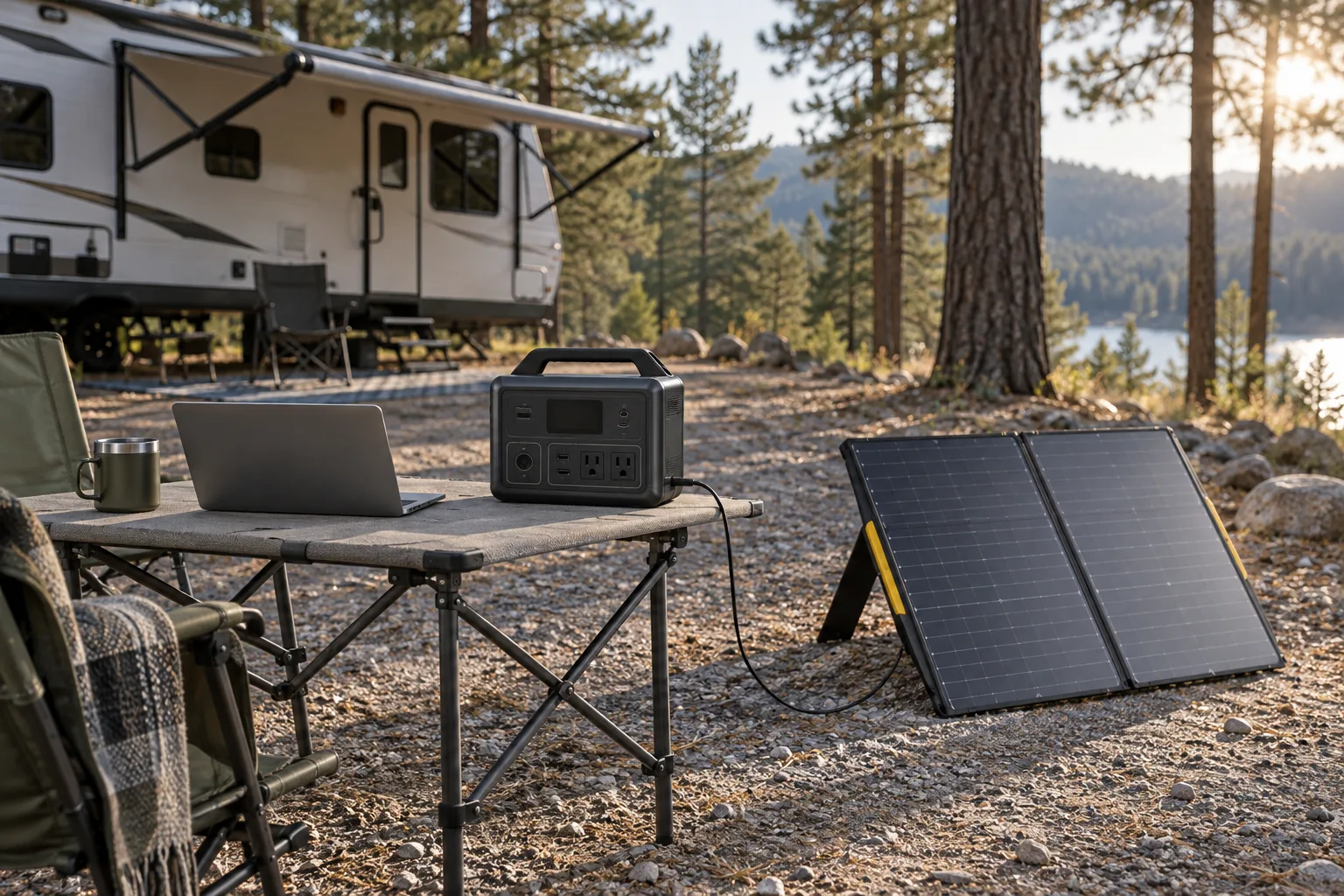
Why RV sizing is more than a wattage badge
RV power can include shore power, a house battery, a converter/charger, solar panels, an inverter and a generator. A portable station may supplement one of those paths, but it does not automatically replace the whole system. The first decision is whether you want to run selected plug-in loads, recharge the RV battery, or feed an approved RV inlet.
RV compatibility checklist
- 01Map the service. Identify the RV inlet type, shore-power cord, breaker rating and whether the coach expects 120V only or a split-phase 50A service.
- 02List the simultaneous loads. Include refrigerator mode, water pump, furnace blower, fans, chargers, microwave, air conditioner and any laptop or entertainment equipment you plan to use together.
- 03Separate battery charging from load powering. If the station charges the RV battery through a converter, account for conversion losses and the converter’s own draw.
- 04Check solar input. Confirm panel voltage range, connector type, current limit and whether panels are series or parallel. A panel nameplate is not a guarantee of harvest.
- 05Verify the connection method. Use manufacturer-approved cables, adapters and transfer equipment. If a hardwired or inlet connection is involved, ask an RV electrician.
A planning table for common RV questions
| Question | What to compare |
|---|---|
| Can it run the air conditioner? | Continuous and startup output, voltage, thermostat cycling and battery drain. |
| Can it recharge the house battery? | Charging voltage, current, converter behavior and the energy lost in the path. |
| Will it power the microwave? | Running watts, startup behavior and what else is on at the same time. |
| How long will it last off-grid? | Usable Wh against the daily energy budget, plus solar recharge opportunity. |
| Can I plug into the RV? | Inlet/service type, adapter rating, grounding, transfer and manufacturer instructions. |
Make a daily energy budget
List each load, its average watts and hours per day. Add the watt-hours:
Then compare that total with the usable battery energy and expected solar harvest. If a load is a motor or compressor, add its startup requirement to the inverter check separately. The wattage calculator handles the simultaneous-load side; the runtime calculator handles one estimated load at a time.
FAQ
Can a portable power station run an RV air conditioner?
Is a 30A adapter safe with any power station?
Should I compare RV power stations by amp-hours?
Planning guide · United States context · Updated September 20, 2026. Product lines, firmware, port standards and manufacturer limits change; verify the current manual before buying or connecting a load.